You paste old newsletters into AI and type "make it sound like me."
Back comes a draft that sounds a bit like you.
It still picks like everyone else. Reading it was wasted time.
I asked Claude to guess my subject-line winners blind.
Eight of ten right. Wrong on the one big test.
So stop letting AI choose.
To teach AI your taste, give it your pick and your reason, in one line.
Keep every line in a log it reads before each job.
It works the same in ChatGPT, Claude or Gemini. That's how you teach ChatGPT your preferences too.
The One Test Claude Got Wrong
Between August and October 2026, I ran 12 subject-line A/B tests in beehiiv.
That's where my newsletter goes out. Two of the tests were ties.
I gave a fresh Claude chat the subject lines. No results, no tools.
Then I asked which line my readers opened more.
On the other ten, it matched them 8 times.
Sounds good. Most of those tests were too small to mean anything, though.
Fair to Claude: my list isn't massive, small but growing.
It told me to check how big each test group was before trusting its picks.
It also warned that Apple Mail privacy can make open rates look higher than they really are.
Only one test was big enough to count: 86 people on each side.
Claude got that one wrong.
| The big test (86 people each side) | Subject line | Opened |
|---|---|---|
| Readers' winner | "Five charges in one day: $127" | 34.88% (30 of 86) |
| Claude's pick | "My $47 AI plan cost me $174 in August" | 20.93% (18 of 86) |
My readers opened the sharp moment with a number on it.
Claude backed the line that explains everything.
It wasn't careless. It picked what usually works.
Nobody had told it what works on my list.
That's the same reason ChatGPT drafts come out generic.
Same risk on yours. Send the safe line, and the sharp one never gets its chance.
The readers who'd have opened it scroll straight past.
Taste vs Voice: What Your Samples Never Show
Your voice is how you sound. Your taste is what you pick.
| Voice | Taste | |
|---|---|---|
| What it is | How it sounds | What you choose |
| Where AI gets it | Your writing samples | Your picks and your reasons |
| A rule looks like | "Short sentences, no jargon." | "Choose the line that shows one specific moment." |
AI gets close to your voice from a few good samples.
The picks are harder.
An old issue shows the subject line you sent.
It doesn't show the ones you threw out at 11pm. Or why.
Lon Riesberg found the same when he taught an AI his taste. In his words:
"the rejects, and especially the near misses, turned out to matter more than the picks."
So only you can tell it:
which subject line your readers opened
which intro kept them reading
which old post earned a second life on LinkedIn
Teach AI Your Taste in Five Steps
Spread, pick, say why, judge, log.
You choose. Your readers vote.
The AI does the admin.
The steps below use three jobs from your week.
It's 11pm and the issue is written.
One line stands between you and bed.
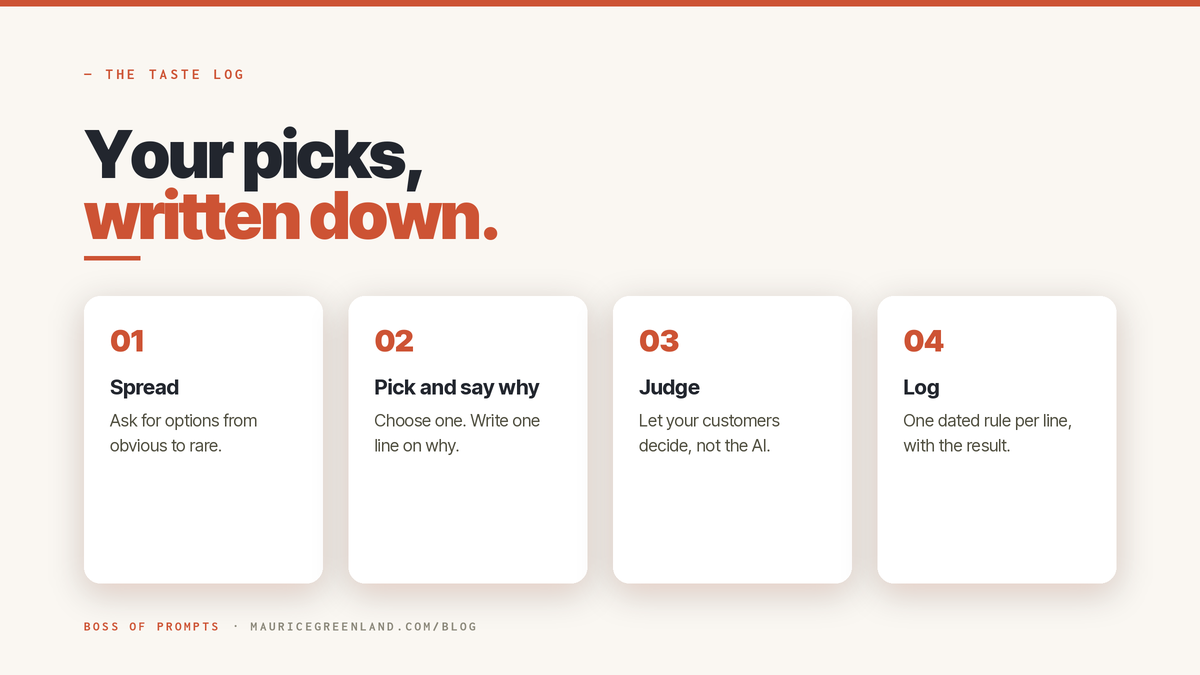
Make AI Show You the Safe Line First
Do this: Ask for several options, ordered from the most obvious to the rarest, and ask how likely each one is.
The odds part has research behind it, from the Verbalized Sampling paper.
In creative writing, it gave 1.6 to 2.1 times more variety than a plain ask.
Try it on tonight's subject line.
Say the issue is about handling a tough exit interview.
Picture the top of your list: "How to handle a tough exit interview."
Further down, something odder: "The exit interview that went quiet for a full minute."
You should now have: a short list. Line one is what every other newsletter would send.
Check: does the rare end read like the top line in a new outfit? Ask again for lines that promise something different.
Seeing the safe one is the point.
Now you can skip it on purpose. Or keep it on purpose.
Choose Your Line and Write Down Why
Do this: Choose one. Then write one line on why, in your own words.
This time, take your opening paragraph.
You've got two drafts.
One starts with the topic. One starts inside a client's problem.
Pick one. Then write why.
Skip "it feels better." Write something a stranger could use next time.
Something like: "start inside the client problem, then say what I did."
That names a choice. "It feels better" names nothing.
You should now have: a reason. That reason becomes your rule.
Check: if you weren't in the room, would your reason still choose your line? If it fits both, it's too loose.
Send the Issue and Let Your Readers Vote
Do this: Use your pick. Send the email, post the offer, make the call. Then wait for the result.
Don't ask the AI whether your pick was good.
Felix Rieseberg of Anthropic put it in one line.
It's in his October 2026 essay on working with models:
"Do *not* ask the model to judge itself."
The AI knows what usually works. Your readers know what works for you.
Say you chose which old post to turn into LinkedIn posts.
Post it. Then watch the comments, not the AI's opinion of the post.
For a subject line, the number is opens. For an opening, it's replies.
A pick with no result is still a guess.
You should now have: a result next to your pick.
Check: is there a number next to your pick? No number yet? Log it as "not yet" and add it when it lands.
Add the Rule to Your Taste Log
Do this: Keep one rule per line. Newest at the bottom, each with the date and the result once you have it.
A log line looks like this:
[date] · Pick [your rule] · result: [opens, replies, yes or no]Say your reason for tonight's subject line was "show one moment, save the story for the email."
That becomes one dated line, with the opens added when they land.
When a new pick clashes with an old rule, settle which one wins.
The prompt below flags the clash. You decide.
Paste the log at the top of your next request, or save it in your AI's settings (see below).
You should now have: an AI that starts from your rules instead of the average.
Check: every line has a date and starts with "Pick" or "Choose."
One Prompt That Keeps the Log for You
Doing that by hand gets old fast. This prompt runs the whole loop.
Give it one real choice, and it will:
name the safe option
turn your reason into a rule
flag any clash with your old rules
hand back the updated log
if the result went against you, suggest a rule from the winner, marked "suggested"
It's #233 in my free library, the Taste Log prompt.
It passed when I ran it in Claude on my own subject-line data.
Looking for AI to decide for you? Wrong prompt.
It won't grade your pick.
Same if every issue comes off one template. With nothing to choose between, it has nothing to work on.
Stay if your week is full of small calls like these.
Swap the [bracketed bits] for one real choice you've made. Start with the last subject line you sent.
Fill it in like this:
What I was choosing: this week's subject line.
The options I had: the lines from your list.
Why: your one line, in your words.
What happened: the open rate, or "not yet."
You help me write down my taste, so AI stops handing me the safe, average option.

Here is a choice I made:

What I was choosing: [a subject line, a price, a product name, a proposal opening...]

The options I had:
[option 1]
[option 2]
[more, if you had them]

The one I picked: [your pick]
Why, in one line, in my own words: [your reason]
What happened, if I know yet: [opens, replies, a yes or no from the client, or "not yet"]

My Taste Log so far: [paste it here, or write "none yet"]

Now do five things:

1. Tell me which option most people in my shoes would pick by default, and why, in one line. That is the safe choice. Say if my pick is the same one.
2. Turn my reason into one rule I can reuse next time. Start it with "Pick" or "Choose". Make it about my business and my customers, not general advice.
3. If a rule already in my Taste Log points the other way, quote it and ask me which one wins. Do not decide for me.
4. Give me my updated Taste Log: one rule per line, newest at the bottom, each with today's date and the result if I gave one.
5. If the result went against my pick, say so in one line. Then suggest one rule the winning option points to, marked "suggested", so I can keep it or drop it.

Use only what I told you. Do not add rules I did not give you, apart from the one marked "suggested" in step 5, and do not tell me whether my pick was good. The result decides that.
What It Gave Me on the Big Test
Step 1 named the $47 line as the safe choice.
That's the line Claude had picked blind. It's also the one fewer of my readers opened.
If your pick matches the safe one, ask yourself: is that you, or habit?
Step 5 then suggested a rule from the winning line.
It read:
"Choose the subject line that shows one specific moment of the AI-bill pain, like five charges in one day, and saves the full story for the email."
It came back marked "suggested." Keeping it is your call.
Where to Save Your Taste Log
Save it where your AI reads it before every chat.
| Tool | Where to save the log | What it covers |
|---|---|---|
| ChatGPT | Custom instructions, or a Project's instructions | Custom instructions apply to every chat. A Project keeps related chats, files and instructions together. (overview) |
| Claude | Instructions for Claude, or Project instructions | Project instructions only apply to chats inside that project. (Claude help) |
| Gemini | Instructions for Gemini, or a Gem for one recurring job | Google says Gems move to skills on personal accounts from November 2026. (instructions, Gems) |
Those are the menu names in October 2026. Keep your master copy in a doc you own.
Start with Tonight's Subject Line
Claude knew what usually works.
Only my readers knew what works on my list. Only yours know what works on yours.
So take one choice you made this week.
Run it through the Taste Log prompt. Save the log it hands back.
Add the result when it lands.
One choice tonight. One rule by the time the opens come in.
Frequently Asked Questions
Can AI Learn Your Taste?
Inside what you give it, yes. It doesn't learn you for good.
It reads the rules you saved, each time. Keep the log yourself and take it to any tool.
Can I Teach ChatGPT My Preferences This Way?
Yes. Save your Taste Log in custom instructions (table above).
It's plain text, so any AI that reads text can use it. I tested the prompt in Claude.
How Many Choices Before It Works?
There's no set number. One choice gives you one rule for your very next issue.
The log gets more useful each time a real result lands on it. The near misses teach it most.