You want a ChatGPT voice clone that sounds like you, not as dull as Jamie Dutton from Yellowstone. But how do you get it right — how many writing samples to train ChatGPT to sound like you? 1, 2, 3,... 50? Does it matter?
Well, that's exactly the question we are going to answer in this post. By the end, you will know exactly how many pieces of content you need to create your very own voice clone and end the nightmare of robotic AI text. Let's get started.
Ps- The example in this post is for LinkedIn, but this technique will work for any kind of AI text content you need to make. You can apply the same approach to emails, social media posts, product descriptions, etc.
What You Need Before You Start
Three things. Five LinkedIn posts you wrote yourself and like how they sound. A ChatGPT account (free works; so does Claude). Thirty to forty minutes to put it all together and test your new voice clone.
After that, the voice profile can be reused forever.
Why your own posts and not "good examples"? Because the model can only copy patterns it can see. Give it someone else's writing, and it learns their voice.
Generic input is why most writing prompts fail. And LinkedIn's AI detector now punishes AI slop. Human-written posts are outperforming AI on LinkedIn.
Dwell time, saves, comments, real human interaction — all better on posts written by actual people than on ones spat out of an AI factory.
Step 1: 5 Writing Samples
Do this: open your LinkedIn profile, go to your activity, and pull up your past posts. Pick the five that pass two tests: they performed (comments, saves, DMs), and they sounded like you when you re-read them out loud.
Aim for a mix, at least one story, one tactical post, one opinion.
Paste all five into one document. Strip out hashtags, links, and emojis; you only want the words. Label them Post 1 through Post 5. Roughly 800 to 1,200 words total is enough to train ChatGPT well.
Check before moving on: read each post out loud. If one makes you wince, swap it. A weak sample teaches ChatGPT a voice you don't want.
Step 2: Run the Voice Analysis Prompt
Most prompts ask the model to write blind. This one makes it read all your content and decipher your writing style first. Then it can replicate that voice consistently across new pieces.
Do this: start a fresh chat, paste your five labeled posts, then paste this prompt below them:
Prompt
What you should get back: a six-part analysis quoting your own lines, ending in a VOICE RULES block. Something shaped like this:
Voice Rules
Save these in a note pad
I ran this on five of my own past posts. The rules came back tailored to my writing — not generic filler — and now they live in my Custom Instructions.
That helps ChatGPT hold my voice across everything I make, from social posts to articles.
I still refine them every few months based on which of my posts are performing well.
Step 3: Correct the Rules It Got Wrong
The first pass is always 80 to 90% right, and the wrong 10% matters.
Do this: go through the VOICE RULES line by line and ask one question per rule: Can I point to the sample that proves this? Delete any rule you can't trace to your own posts.
Then add the one or two rules it missed, you'll know them on sight ("I always name the client's industry", "I never open with a number").
Check before moving on: every surviving rule has evidence in your five posts. Ten to twelve rules are plenty. More than fifteen means it's too vague and might start drifting away from your true voice.
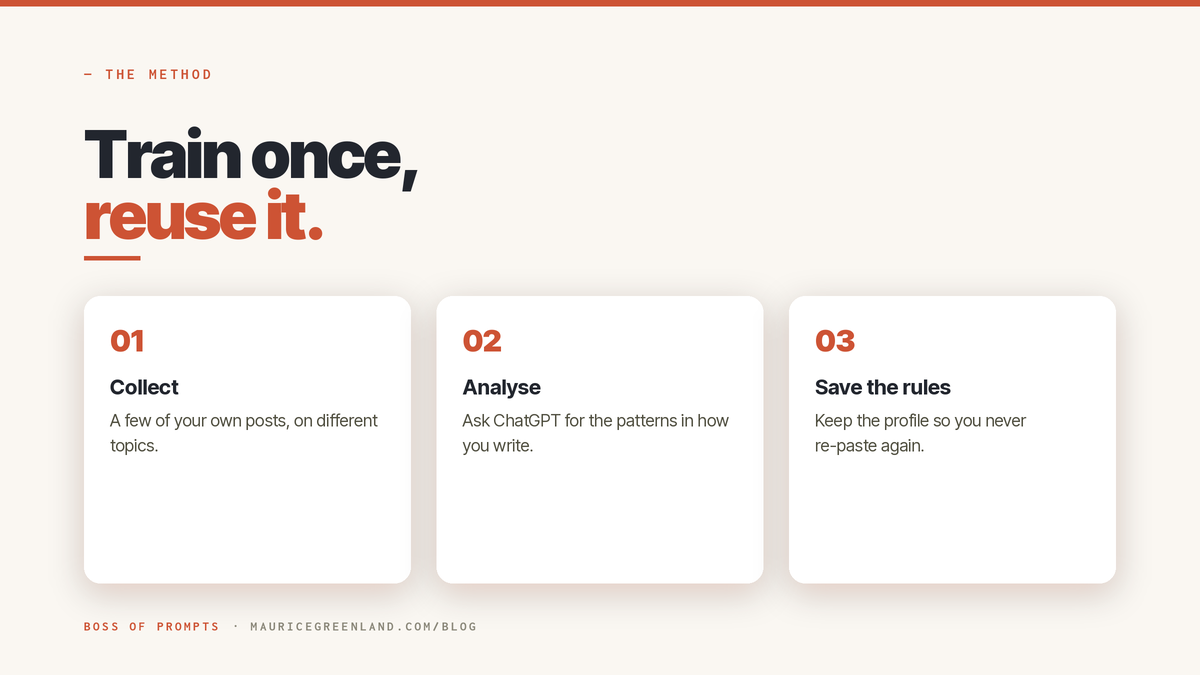
Step 4: Save Your Voice Rules for Reuse
A profile you re-paste every day is a profile you'll abandon by Friday.
Do this: put the corrected VOICE RULES block somewhere that every chat can load it. In ChatGPT, that's Custom Instructions or a dedicated Project with the rules in its instructions.
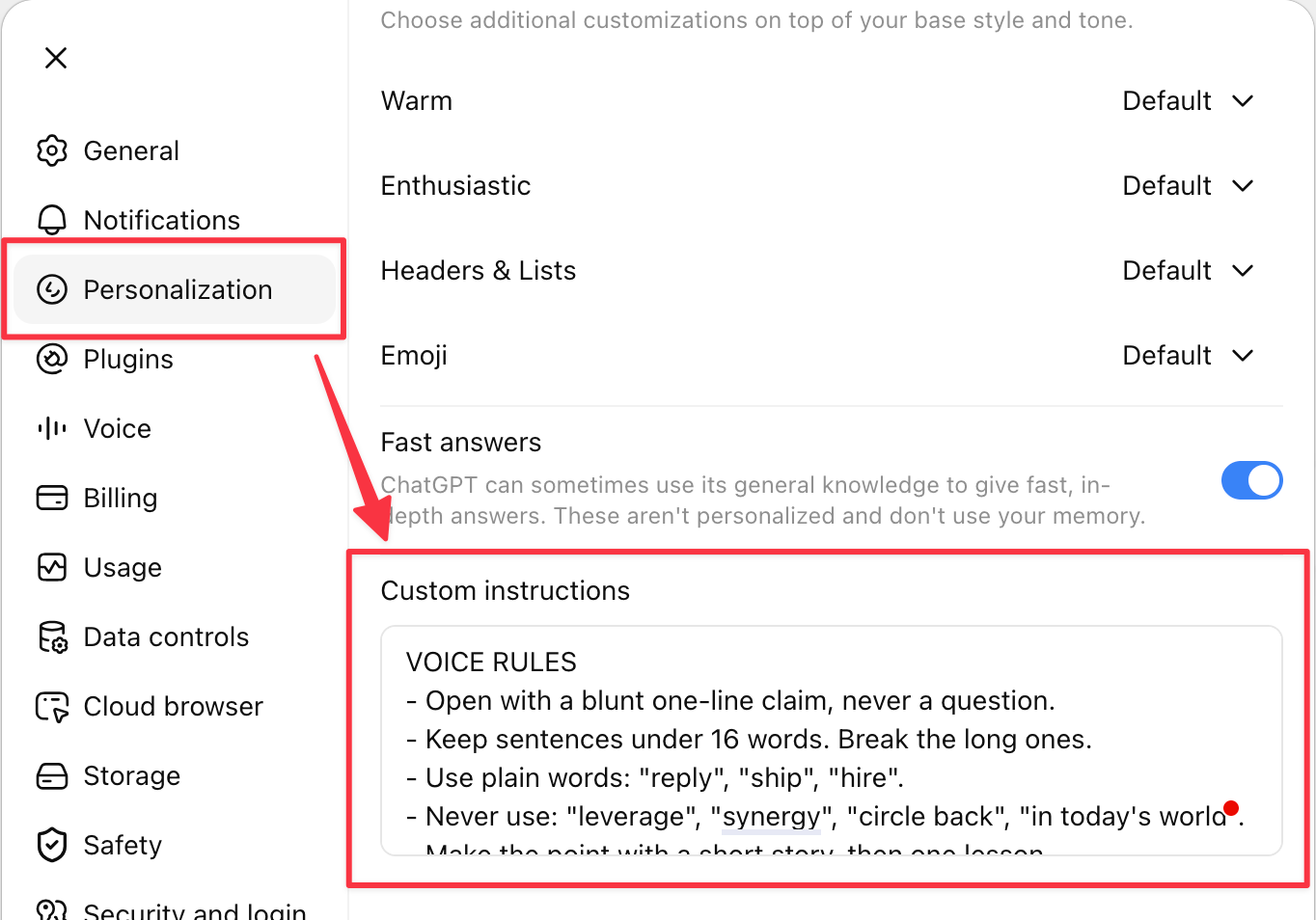
In Claude, a Project does the same job.
Or, if you prefer, you can keep the block in a note and paste it as the first message in any writing chat you start.
Step 5: Brief Each Post with PACT
The rules fix how you sound. The brief fixes what the post says. Vague in, generic out.
Do this: for every new post, give ChatGPT four lines before it writes. PACT: Purpose, Audience, Context, Tone.
Prompt
Swap in your own four lines each time. The Context line does the heavy lifting, it's the part only you know.
Step 6: Edit the Last 20% Yourself
Never publish the raw draft. The voice profile and PACT prompt get you 80% of the way; the last 20% is the human detail no prompt can add.
Read the draft out loud. Cut any line that repeats itself and swap every vague phrase for a concrete one ("optimize your workflow" becomes "block 30 minutes on Tuesday").
Then add one detail only you could know: the client's exact words, the statistic you remember, the chat you had in a DM.
Here's the difference in one post, a hypothetical about a hiring mistake.
Generic draft:
Hiring is one of the biggest decisions a leader makes. Three lessons from a hire that didn't work out: culture fit matters, skills can be taught, trust your gut. What's yours?
Same topic but using voice rules, then edited:
I hired for the impressive CV and ignored the flat interview. Six weeks later we both knew. The lesson wasn't "trust your gut." It was that I knew on day one and talked myself out of it.
The second one is the clear winner. Sound authentic, natural, and genuinely useful to your actual audience.
The Wrap-Up
Do Step 1 today: get your 5 best posts together —shouldn't take you more than 10 minutes. If you'd rather start with a shortcut, the free Voice Sketch drafts a starter profile from three posts. Try it out.
Frequently Asked Questions
Can ChatGPT Learn to Write Like You?
Yes, if you train ChatGPT to write like you with your own samples and a saved rules block. It copies patterns it can see: sentence length, word choice, and how you open. Five real posts, corrected rules, and your edit close the gap.
How Many Writing Samples Is Too Many?
More than 10 - 12. Past that point the model averages across too much material and the rules come back mushier, not sharper. Five strong posts beat fifteen mixed ones every time.
Will LinkedIn Penalize AI-Written Posts?
LinkedIn doesn't penalize AI use itself, but its ranking suppresses generic, low-effort posts. Posts that earn dwell time and real comments do better, whoever drafted them.
How Do I Stop ChatGPT Sounding Generic?
Give it a voice profile built from your own posts, brief it with PACT, and always edit. Cut the hook question, the three-bullet list, and the "what do you think?" close, those are the tells. Add one detail that only you know.
How Many Writing Samples to Train ChatGPT
Five good posts and a saved voice profile beats 10 to 20 long form posts. Grab your best five articles and use those to create a voice profile you can give the model. You'll be surprised how quickly the model learns your style and preferences.