Your price feels like a guess. It probably is. Most sellers pluck a number from thin air, then hope nobody asks why.
There's a better way to price digital products. Price the outcome, not the effort. Name the result, put a rough value on it (a number you can defend), then compare to comparable products.
That's the whole method. Simple enough. The hard part is running it without fooling yourself about what a realistic number is.
I use this on my own Gumroad products. I'll show you, step by step, how to find the best price for your digital product that drives sales. Keep reading.
Why Cost-Based Pricing Fails for Digital Products
Cost-based pricing works when every copy costs you something. Digital products don't work like that — you make the thing once, and the next thousand copies cost you basically nothing to deliver.
Your marginal cost is near zero, so cost can't be your floor. There's nothing to add a margin to.
That's rule one: cost is a fact, not a floor.
The trap is emotional, not mathematical. You spent 10 hours on a template, so $9 "feels right." But the buyer isn't paying for your ten hours — they're paying for the afternoon your template saves them every week. They care about the outcome, not your graft. So price the outcome.
Effort-based pricing also races you to the bottom. There's always someone who spent fewer hours and charges less — and a $3 price tag on a "saves you hours" product just makes buyers assume it doesn't work.
Anchor to value instead. Ask yourself: what would customers be willing to pay to make this problem go away? That's your number. Pin your number to the value, not the effort you put in.
Step 1: Name the Outcome Your Product Solves
One sentence, concrete, and measurable:
"Build a five-page portfolio site in a weekend." "Send client proposals in twenty minutes instead of an evening." "Stop guessing which product idea to build next."
If you can't write that sentence, you have a pricing problem upstream: the product's job isn't clear yet.
Narrow the scope until the sentence writes itself. (And if you're not sure the job is one people pay for, run the free product idea validator before you spend another hour building.)
Prompt from the Vault
Know if your Gumroad idea is worth building
Know if your product is worth making
Prompt
Step 2: Put a Number on That Outcome
Translate the outcome into money, time, or avoided mistakes, using the buyer's numbers, not yours.
A worked illustration (the numbers are hypothetical, the logic is the method):
If a proposal template saves a freelancer 2 hours per proposal and they write 3 a month, that's roughly 6 hours a month. Even at modest freelance rates, the template pays for itself in the first proposal.
A price between $15 and $49 is trivially defensible against that maths; $3 would actually undermine your claim.
The buyer never sees this arithmetic. You do it so that when you write "saves you an evening per proposal" next to a $29 price, both halves of the sentence agree.
Step 3: Sanity-Check Against Your Competitors
Now look at what comparable products charge. Find the range and see if there is a trend. If you can find the products that solve a problem as close to yours as possible.
The market range is a sanity check; it tells you what buyers in this category are used to, not what your product is worth.
If your number lands far above the range, you need proof on your sales page why yours is worth more or a narrower, more valuable promise. If it lands below, raise it or say why it's low on purpose.
Matching the cheapest competitor for no good reason just marks you as replacable by another competitor product.
Should You Use Pricing Tiers? Usually Not at First
Here's where I'll disagree with nearly every digital product pricing guide out there. The typical advice? "Offer three tiers."
I tested that on my own products — it didn't go well. My pricing prompt dutifully spat out the three-tier structure the internet loves, but the Premium tier was a joke —no real added value I could justify: padding dressed up as value, invented bonuses nobody asked for.
That's what "always use tiers" gives you when a product doesn't naturally warrant 3 tiers.
So I rewrote the prompt. Now the tier step is conditional — it recommends a single price unless there's a credible second or third offering that a real buyer actually wants.
The rule: tiers earn their place when different buyers genuinely need different things (the file vs. the file plus a walkthrough vs. a done-with-you session).
If you had to invent content to fill a tier, you don't have tiers — you have one price wearing a costume. One clear price beats three unconvincing ones.
Pricing on Gumroad Specifically
Three Gumroad-specific things change the calculation:
Pay-what-you-want. On Gumroad, PWYW lets you set a $0 (or higher) minimum with a suggested price.
It works when reach is the goal — a $0 minimum kills every excuse not to try, and buyers who get value routinely pay the suggested number.
I ran PWYW with a $0 minimum and a suggested price on every pack for exactly that reason. In August 2026 I moved all of them to a flat $15. If your goal is pure revenue on a proven product, then a fixed price works better. Neither's "correct" — different goals.
Watch the $100 cap: products over $100 can't appear in Gumroad Discover. If marketplace traffic matters, price under it (Gumroad only).
Gumroad handles sales tax and VAT, and its cut comes off the top of your price, so decide your take-home price first.
Prices ending in 9 or 7 have a positive buy signal to potential customers.
Can you change the price later? Absolutely, as long as the new price is defensible by the value it delivers. Nobody remembers the old number but you.
How to Price Digital Products by Outcome
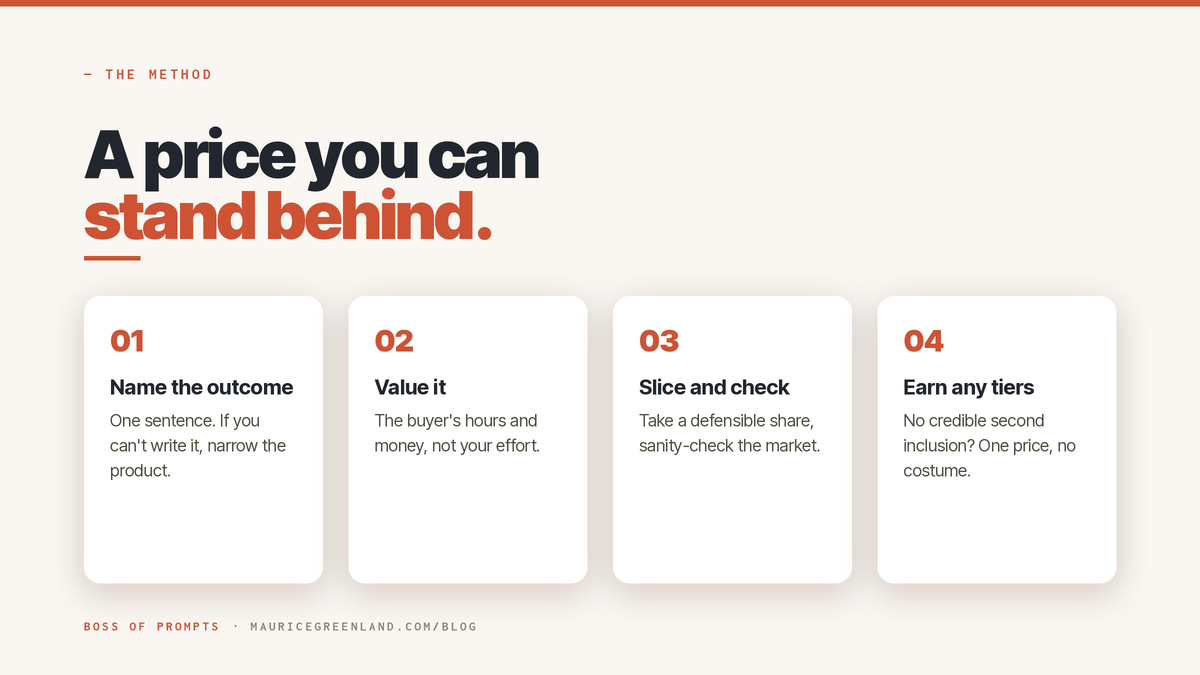
Worth writing down where you'll see it:
Name the outcome in one sentence. Can't write it? Narrow the product until you can.
Value the outcome with the buyer's numbers: hours saved, money earned, mistakes avoided.
Take a defensible slice of that value, then sanity-check it against the visible market range.
Skip tiers unless a second tier's contents already exist and a real buyer segment wants them.
On Gumroad: PWYW with a suggested price when reach matters, fixed when it doesn't, and stay under $100 if Discover traffic matters to you.
When you raise a price later (you probably will), change one thing at a time and watch what happens for a few weeks. A price change tells you something about your buyers either way; two changes at once tell you nothing.
Once you have a price you are comfortable with, the sales page has to drive that value home.
That's covered in how to write a Gumroad product description. The full prompt system is in the Gumroad Seller Skills pack.
Wrap-Up: One Defensible Number
So that's the whole strategy. It's deliberately not complicated, and each step follows on from the last. One method, run on real numbers.
A price with a strong reason behind it survives the eyebrow test, and guesswork pricing quietly crushes everything else you try to sell.
Now run it on one product. It takes about twenty minutes, and the outcome sentence is the hard part. If that sentence won't write, that's where you really need to hone in on your product offering.
Frequently Asked Questions
How Much Should I Charge for a Digital Product?
Work it out from the outcome: name what the product lets the buyer do, put a rough value on that, and take a defensible slice, then sanity-check against what comparable products charge. For most solo-creator templates and packs that lands between $9 and $49. A number you can justify out loud beats any formula. The same maths tells you how much to charge for digital downloads of any kind: value first, market second.
Is Pay What You Want a Good Idea on Gumroad?
Yes, when reach is part of your goal. A $0-minimum PWYW price with a visible suggested price removes friction for new buyers while signaling what the product is worth, and Gumroad still generates license keys on $0 purchases if your delivery depends on them. For a proven product where revenue is the only goal, fixed pricing anchors harder.
Why Is My Digital Product Not Selling Even Though It's Cheap?
Often because it's cheap. Buyers with no other signal read price as quality, and a very low price on a big promise reads as "probably doesn't work". Cheap also doesn't fix the usual real causes: an unclear page, no proof, or no traffic. Diagnose those in order before touching the price again.
How Do You Price Digital Products on Gumroad Specifically?
Same method, three platform facts on top: pay-what-you-want with a suggested price works when reach matters, products over $100 lose Gumroad Discover eligibility, and Gumroad's cut comes off the top, so set your target take-home first and price up from there.
Should I Offer Pricing Tiers?
Only if different buyers genuinely need different things and each tier's contents already exist. If you'd have to invent bonuses to fill a Premium tier, use a single price. I tested the "always use three tiers" advice on my own pack and the result was a hollow top tier; one honest price converts better than three unconvincing ones.