Knowing how to reply to a difficult client email calmly and clearly can save your freelance business overnight-- and your sanity.
You know the dreaded email. The client wants free work, thinks your invoice is optional, or they're angry about something that's only half your fault. You want to stay diplomatic *and* firm — but most of us can only manage one at a time. An hour later, nothing sent.
If you're the sort who's sometimes too nice to say no (guilty 🙂), that gap is the whole problem. Here's the answer — and it works for almost every difficult client email you'll ever get.
3 Moves for Any Difficult Client Email
Difficult replies go wrong because they try to do too many things at once. They defend, explain, apologize, argue, and somewhere in the pile, the actual point drowns. A reply that works does exactly three things, in order.
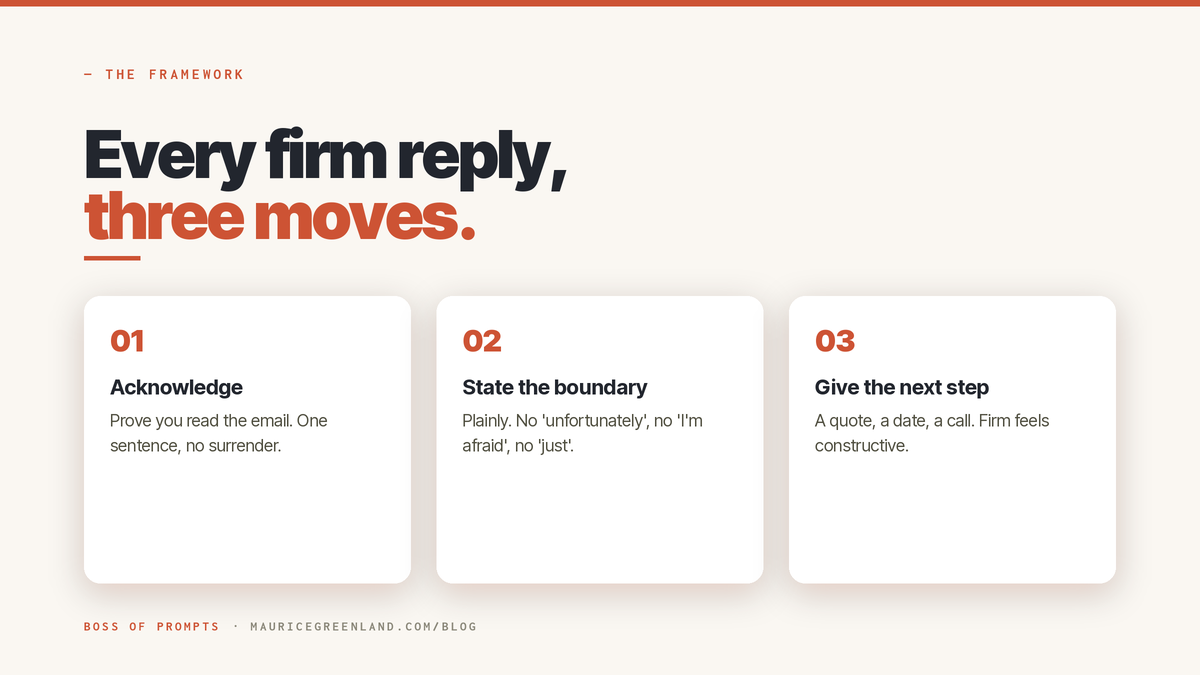
Acknowledge the person. One or two sentences that show you read their email and take it seriously. Not agreement, not apology. "Thanks for being straight about the budget," acknowledges. "I'm so sorry, I completely understand, my rates probably are high," surrenders. The acknowledgment is what lets everything that follows land as businesslike rather than defensive.
State the boundary, plainly. One sentence, in the same tone you'd use to state your address. "The current scope covers the site pages, so the email templates would be a separate piece of work." No "unfortunately", no "I'm afraid", no "just". Those words feel polite when you type them — but on the client's screen, they read as a confrontation.
Give the next step. End with one concrete thing that happens now: a quote arriving Thursday, an invoice date standing, or a call if they want to talk it through. The next step is what makes a firm email feel constructive instead of cold. It moves both of you from the disagreement to the path out of it.
Say No to Free Work, Keep the Client
Scope creep is the most common version of this conversation for freelancers, so let's start there.
Acknowledge: "Good idea, and I can see why you want it in this phase."
Boundary: "It sits outside the scope we agreed in March, so it would be its own piece of work."
Next step: "I can quote it by Thursday if you want to go ahead." Three sentences, no apology, no argument, and the client still feels looked after.
Notice you never said no to the person, only priced the work. That is how you push back, stay true to your worth, and keep the relationship positive at the same time.
Prompt from the Vault
Turn an ask in to an opportunity
How to respond to scope creep
Prompt
I have burned entire weekends agonizing over a client's Friday-night "one more thing" email. Total weekend killer.
Besides the 3-step system I showed you, you can use templates for the situations that keep coming up. Here's the one I use to push back on clients angling for freebies — without sounding ungrateful or brushing off what they're asking for.
Give it a go.
Ask a Client for Payment Without Sounding Rude?
The same shape applies to money questions.
Acknowledge the relationship, state the invoice plainly, and give a dated next step.
"Hope the launch is going well. Invoice 0142 for $1,200 was due on the 3rd and is still open. Can you confirm it's scheduled for this week?"
No apology for asking, no hardship story, no "at your earliest convenience". Specificity kills stalling, and a concrete date is what gets you paid without sounding desperate.
The trick freelancers miss: send it the day the invoice goes overdue, not three weeks later when the frustration writes the email for you.
How to Reply to a Difficult Client Email -- When They Are Rude?
This is the one people get wrong, because the worst time to draft a reply is while you are still angry, and the worst drafter is the person the email was aimed at. "I don't want to sound aggressive, but I need to be firm" is exactly the tightrope, and heat is what makes you fall off it.
So don't draft from anger-- cool off. Here is a prompt to run before you type anything. Paste it into Claude, ChatGPT, or whichever AI tool you prefer:
The level-headed prompt
Step one is acknowledgment: it forces a separation between feeling and request, so you can answer the request.
Steps two and three look out for the two classic mistakes, over-reading the anger and taking the bait.
Then it applies a hard word limit, because 120 carefully chosen words nearly always beat 400 poorly thought-out ones.
The last line matters—some emails need a same-day answer. Others are safer sent at 9 am tomorrow, when things have calmed down.
This is one of the free prompts you can try right now: decode a heated client email before you reply, and say no to free extra work in under 80 words.
What a Good Reply Looks Like
A good, difficult email reply is short, names the issue, states your position once, and ends with a solution. It should sound deliberate yet natural.
The reply is only half the win; the other win is what stops: no ping-pong threads, unpaid extras, or inbox dread.
Clients often test limits, but calm, clear replies teach most to stop. It won't always work, but clarity and professionalism create a lasting good impression.
Get the Full System
The prompt is part of the Client Email Rescue Pack, which also includes tools for chasing invoices, reviving silent clients, holding rates, owning mistakes, gracefully firing clients, and a voice guide so emails sound like you, not AI.
Each one has been run on real work before it shipped: get the Client Email Rescue Pack.
Frequently Asked Questions (FAQs)
Should I Respond Immediately to a Difficult Client Email?
Not necessarily. If a quick response is needed, draft your reply, step away for a few minutes (go have a coffee), and review it with fresh eyes. Most heated emails are better sent the next morning once emotions have settled. Only urgent deadlines require an immediate reply; otherwise, it’s safe to wait a few hours.
What Should I Do if a Client Is Rude?
Keep calm and try not to be rude in return. Acknowledge their frustration, clearly state your position once, and offer a solution. Staying calm stops the escalation, saves the relationship, and sets boundaries.
Will Pushing Back on Scope Creep Harm My Client Relationship?
Sometimes, but it's often beneficial. Clients who leave over reasonable boundaries were unlikely to stay long anyway. Learning to say no confidently protects your work and your worth without risking long-term client loss.
Can AI Help Craft Client Replies?
Yes. AI can generate effective drafts, but you've got to have the last say. It can follow a framework very well, but understanding your relationship history and final tone decisions needs your input. The goal isn't to let the AI write your response—it's to use it as a thinking partner that saves you time.
How Concise Should My Client Replies Be?
Keep email responses brief. Shorter replies sound more confident and prevent unnecessary back-and-forth. When you ramble, you come across as defensive or unsure of your position.